

Thumbelina: Between Tom Thumb and the Fairies
Myth, symbolism, folklore, and the miniature tradition

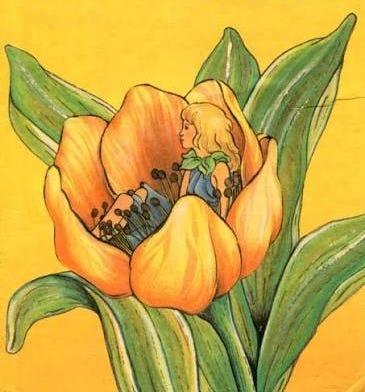
Hans Christian Andersen’s “Thumbelina” (1835) is one of the most famous stories about a tiny person in world literature. No taller than a thumb, its heroine belongs to a long tradition of diminutive characters that stretches from folktale “thumblings” such as Tom Thumb to the miniature people of modern children’s fantasy.
Yet Thumbelina occupies a curious position within that tradition. She is neither quite a folktale hero nor quite a fairy. Her adventures have prompted readings that range from feminist criticism and biography to mythology, Christianity, and disability studies.
What interests me most, however, is the way Andersen combines two miniature traditions: the folktale thumbling and the literary flower-fairy. Thumbelina, I will argue, is a hybrid figure who stands between these traditions and helps create something new in the history of children’s fantasy.
To understand how Andersen achieves this, it is worth beginning with the story itself.
“Thumbelina” was first published in 1835, as one of three tales that formed the second instalment of Andersen’s Fairy Tales Told for Children. First Collection (Eventyr, fortalte for Børn. Første Samling). It follows the trials and tribulations of a thumb-sized girl, from her wondrous birth, to her abduction, wanderings, and near-arranged marriage, until she flies away to find belonging with winged creatures of her size.
Thumbelina’s story goes through a number of much-illustrated episodes:
She is born out of a flower given to her “mother” by a witch
She is abducted from her maternal home by a toad as a bride for her son and placed on a lily pad to stop her escaping
The fish in the river take pity on her and nibble the stem of the lily pad, whilst a butterfly helps her escape quicker
She is then captured by a beetle who later rejects her because the other beetles see her as “other” and different to them
She enjoys the beauty of spring for a while, but as winter comes she is threatened by the elements
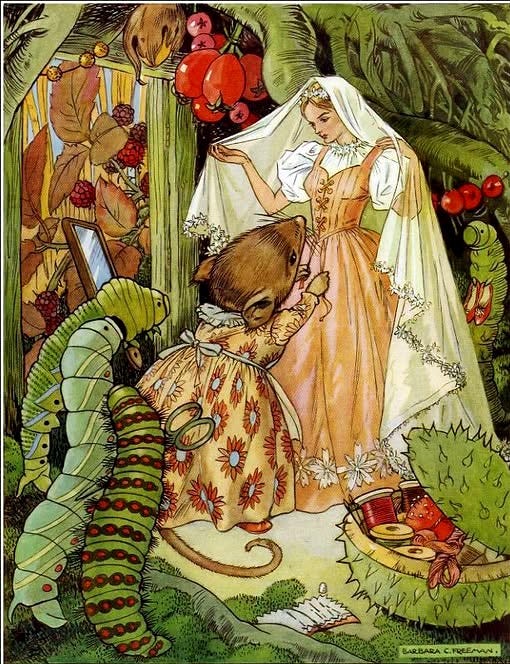
She is taken in by a kindly field mouse, and occupies herself with domestic duties
She is wooed by a mole who wants to marry her and feels obliged to follow the field mouse’s advice and accept him, despite his repulsive characteristics
Meanwhile, she finds a seemingly dead swallow in the mole’s underground passages; the swallow proves to be wounded rather than dead and she nurtures it back to health
As Thumbelina is about to marry the mole, the swallow offers to take her with it to freedom in the “warm countries”
There she finds love and belonging with flower-fairies of her scale and marries their prince; she acquires wings and her name is changed to Maya
Whilst thinking through “Thumbelina” (“Tommelise”, as per her name in Danish), I am first going to survey what different critics over the years have made of this tale. “Thumbelina” has been read as:
a feminist fairy tale
a repository of Andersen’s biographical experiences and anxieties
a retelling of a classical myth
a story steeped in Christian symbolism
an allegory of the spiritual journey
an expression of ideas about disability and impairment
I will briefly go through each of these readings below, before I turn to how this literary fairy-tale is in dialogue with the “thumbling” motif in international folklore and the trope of the diminutive fairy, therefore creating a new hybrid figure who breaks new ground in children’s fantasy about tiny people and miniature worlds.
A (proto)feminist fairy-tale
The “thumbling” tradition, the motif of a tiny character born to normal-sized parents who undergoes adventures in which overcoming his diminutive size is part of the challenge, usually presents us with a male hero. Most anglophone readers will be familiar with Tom Thumb, whilst well-known international versions include Le Petit Poucet (French) and Issun-boshi (Japanese) or Κοντορεβιθούλης (Greek). All of these are tiny boys. Where Hans Christian Andersen made a substantial difference was in presenting us with a female thumb-sized hero, whose trials and tribulations are not only associated with her size, but also with her gender.
As you can see even from the brief outline above, Thumbelina’s adventures are mostly predicated on her efforts to avoid what is, ostensibly, a forced marriage, to creatures that are not of her kind: first she is stolen to become the bride of a toad, and then she is coerced into accepting the old mole as a husband. Maria Tatar appositely calls “Thumbelina” the story of “a runaway bride”1. Throughout the narrative she is never given the opportunity to decide her own fate, but it is her kindness that ultimately saves her: by rescuing the swallow she is rewarded with escaping to a place where she can find a suitable match.
Critics see in the story Andersen’s social commentary on the limited choices for middle-class women of his times. Andersen’s recent biographer Paul Binding argues that:
Thumbelina’ is in essence a picture of the helplessness of the female, innately tender and giving, and therefore exploitable, in the face of those conventions the world has devised and maintained to preserve an inflexible order. […] The notion of Thumbelina being pestered by members of different species from her own succeeds brilliantly as a metaphor for society’s all-but-arbitrary yoking of girls and women to males they neither know well nor care for.2
Niels Ingwersen voices a similar view:
The tiny heroine […] is subjected to the pressure of a society that wants her to conform […], and thus she is headed for one of those semi-arranged marriages that were not uncommon in the bourgeoisie of that time. […] The social pressures on Tommelise, as voiced by the kindly, but utterly conventional mouse, are tremendous, for she represents the persistent and authoritative voice of nineteenth-century bourgeois common sense.3
Thumbelina’s “happy ending” with a fairy prince might also be critiqued as a conventional fairy-tale conclusion, especially since their courtship seems to last a few moments only and to be based on the two of them finding each other attractive. Still, at least Thumbelina is presented with a choice, and she actively consents to his marriage proposal. In the story’s resolution we might read Andersen’s fantastic remedy for what he saw as a social ill of his time.
An (auto)biographical expression
Hans Christian Andersen’s life story has also served as a touchstone for the interpretation of his fairy-tales by many critics. Though there is a danger of reading too much of an author’s biography in what is a deliberately fictional creation, a few elements of the story have invited specific parallels with Andersen’s life:
Thumbelina herself is said to have been inspired by “tiny, witty Henriette Wulff”, his confidante and very loyal friend, whom Andersen saw as a younger sister4. Diana Crone Frank and Jeffrey Frank describe her as “very small, frail, and slightly hunchbacked”, but they also note that there is “no written evidence” to support the theory that she is the origin of Thumbelina5.
The mole seems to have been modelled upon Andersen’s harsh headmaster at Slagelse Grammar School, Simon Meisling, who mocked Andersen’s creative efforts and banned him from writing poetry6. Cai M. Woel described Meisling as mole-like, “below average height with a very round head […] his mouth thin, his nose bulbous […] His body was plump with a protruding stomach, big flat feet and short arms […] Something about the man’s appearance made you think about the underworld.”7
The “warm countries”, where Thumbelina’s journey concludes, where the sun shines bright, the sky seems “twice as high”, and there are grapes, lemons and oranges, is probably an allusion to Italy, where Andersen had travelled the year before writing the tale. Andersen found Italy beautiful and liberating. As Rumer Godden writes of his visit to Italy, “there was a quality in him that the North had chilled and stilled; now it was released and everything seemed larger, warmer, more free”8. It is no wonder that Thumbelina also finds her true self there too.
Thumbelina’s ‘birth’, magically, from a flower, rather than through sexual intercourse, has been connected with Andersen’s own ambivalent sexuality and celibacy. Binding claims that it “may well conceal certain psychological revulsions of Andersen’s own, revealing his own recoil from overt sexual behaviour”.9
Last but not least, one can’t blame biographical critics for showing a particular interest in this story, as Andersen inserted himself in the narrative at the very end. After the swallow bids farewell to Thumbelina, he flies back to Denmark to tell his story to Andersen, who claims to have heard it first hand:
“Farewell! Farewell!” said the little swallow as it flew away from the warm lands back to faraway Denmark, where he had a little nest above the window of the man who can tell you fairy tales. To him the bird sang, “Tweet, tweet! Tweet, tweet!” and that’s how we heard the whole story.10
Maria Tatar notes that this ending brings the narrative closer to oral storytelling (the origin of most fairy-tales) and can be seen as a genre convention, but she also argues that it connects Andersen with Thumbelina herself, marking them both as “misfits”11. If Thumbelina could find her happy ending somewhere far away, in a brighter, happier place, perhaps Andersen himself could hope for belonging?
